Week 27 at the Pole

They’re watching something—but what? This is the communications (or “Comms”) office at the South Pole station. Not normally the site for recreational activities, but last week it played host to participants in an international darts tournament among the Antarctic stations. […]

Read More »


A combined analysis of the astrophysical neutrino flux in IceCube

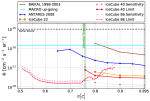
The IceCube Collaboration is now revisiting these results in a combined analysis accepted for publication in The Astrophysical Journal. The analysis is based on the results of six individual studies and uses up to three observables—energy, zenith angle and event topology—to derive improved constraints on the energy spectrum and the composition of neutrino flavors of the astrophysical neutrino flux. […]

Read More »


2015 GNN Dissertation Prize awarded to van Santen and Yáñez

Jakob van Santen, a former graduate student working on IceCube at the Wisconsin IceCube Particle Astrophysics Center (WIPAC) and currently a postdoc at DESY (Deutsches Elektronen-Synchrotron) in Zeuthen, and Juan Pablo Yáñez, also working on IceCube at DESY in Zeuthen, were recently awarded a Dissertation Prize from the Global Neutrino Network. This is the first year that the GNN Dissertation Prize has been awarded. It recognizes young postdoctoral candidates who have written an outstanding thesis and contributed significantly to their projects. […]

Read More »


Week 26 at the Pole

Ah, the 4th of July—barbecues everywhere, even at the South Pole. But, not only is it winter there now, with snow and ice, it’s been extremely cold lately, with long stretches of low temperatures, down to below –100 °F. […]

Read More »


What the atmospheric muon flux in IceCube can tell us about cosmic rays, or even about particle interactions

In a new study presented a few days ago, the IceCube Collaboration reports the potential of atmospheric muons detected in IceCube to help our understanding of important properties of cosmic rays in a wide range of energies. These muons are also shown to be useful for investigating systematic uncertainties in neutrino studies in IceCube. Measurements of the composition of primary cosmic rays, the high-energy spectrum of muons, and the prompt flux are three of the highlights of this paper, which was submitted last Friday to Astroparticle Physics. […]

Read More »


Week 24 at the Pole

If you blur your vision slightly, the green tablecloth might be mistaken as grass and the entire scene as one of a summertime outdoor picnic. But it’s still winter at the South Pole—midwinter to be precise, one of several milestones they traditionally celebrate with a special dinner. […]

Read More »


Week 22 at the Pole

They’re getting fancy at the Pole—wide angles showing off curves and long exposures leaving star trails in the night sky. With its long stretch of darkness broken only by spells of auroras or the rising of a sunlike moon, winter makes the South Pole a captivating place. […]

Read More »


An IceCube neutrino alert triggers the discovery of a supernova

On March 30, 2012, IceCube detected two high-energy neutrino events. IceCube immediately sent an alert to several optical and X-ray telescopes—the Robotic Optical Transient Search Experiment (ROTSE), the Palomar Transient Factory (PTF) and the Swift satellite—and a core-collapse supernova was discovered in the PTF images. However, physicists have shown that this was a coincidental discovery and that this supernova is not likely to be the source of the neutrinos in IceCube. These results have been submitted today to the Astrophysical Journal and are the outcome of a joint study between the IceCube Collaboration and members of the PTF Collaboration, the Swift Collaboration and the Pan-STARRS1 Science Consortium. […]

Read More »