The so-called “hierarchy problem” remains one of the biggest unresolved questions in modern physics. It asks why the weak force, which governs transformations between different types of quarks, is trillions upon trillions of times stronger than gravity. This discrepancy causes major holes in our theoretical understanding of particle physics. For example, without an explanation for this discrepancy, the mass of the Higgs boson particle would not remain stable.
One of the proposed explanations lowers the fundamental scale of gravity by introducing extra dimensions in addition to the familiar three spatial dimensions. These dimensions are expected to be small and inaccessible to particles, except for theoretical “sterile” neutrinos that would only interact with gravity. Another theory lowers the gravity scale by proposing the existence of a “mirror” or copy of the Standard Model in particle physics.
In a paper submitted to Physical Review D, the IceCube Collaboration tested these low-scale gravity scenarios using high-energy neutrinos detected by the IceCube Neutrino Observatory at the South Pole. They did not find any evidence of such features, and limits were set on the models’ allowed parameter space.
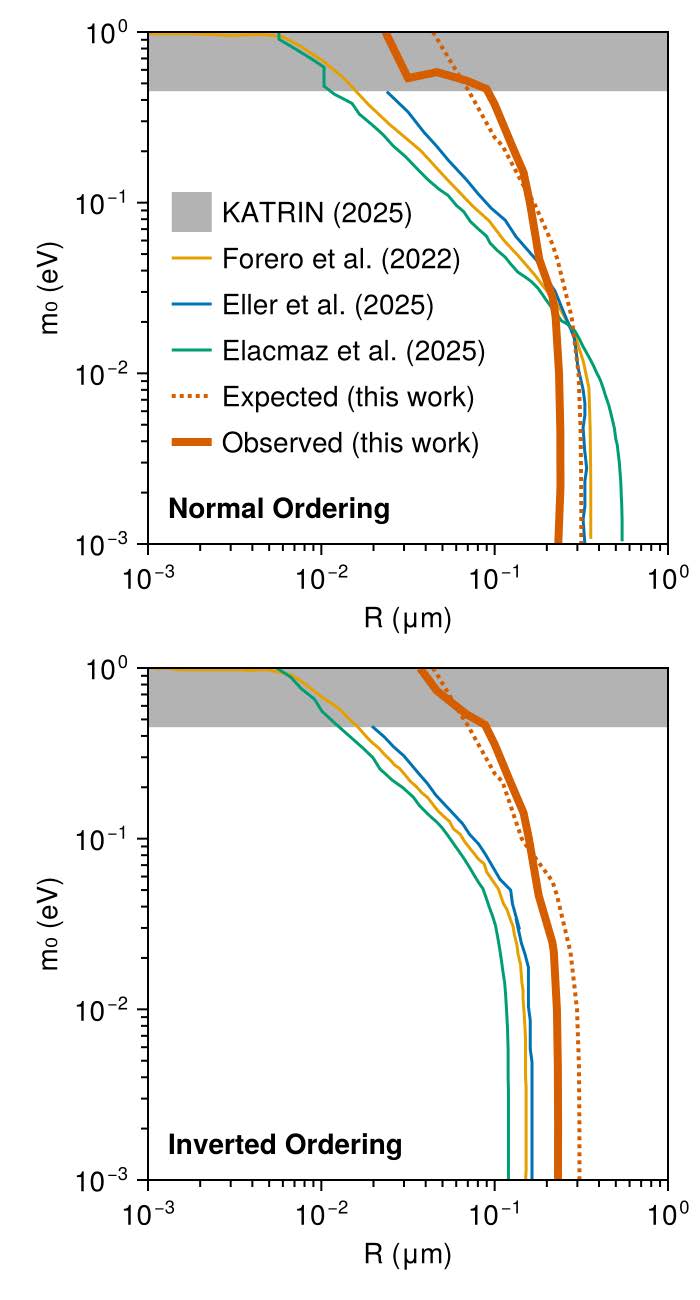
The researchers examined almost 11 years of data consisting of neutrino track-like events. Using this data, they searched for characteristic, local distortions in an otherwise smooth spectrum of antineutrinos that pass through Earth.
“I am very happy to have been a part of this project, where we explored intriguing possibilities for physics beyond the Standard Model and, together with a great team, contributed to advancing our understanding of what nature allows,” says Alan Zander, who did the work while a PhD student at Technische Universität München (TUM). “One particularly interesting aspect of our research was using matter effects to test these theories, providing a novel approach.”
Zander coled the study along with Agustin Urruty, who contributed to the work while a Master’s student at TUM, and Philipp Eller, a staff scientist and research group lead at TUM.



They concluded that if extra dimensions were to exist, that they would be smaller than 0.17 micrometers. Similarly, depending on the mass scale, several hundred copies of the Standard Model particles are needed to make the traces they leave in IceCube undetectable.
“I am so proud and grateful for the team that we were able to build around this research, with Philipp, Alan, and me united by a shared goal, alongside IceCube collaborators like Carlos Argüelles, Philip Weigel, and Alex Wen, from whom we felt that same dedication and passion for science,” says Urruty.
With this analysis and future IceCube studies, scientists are looking to confront theoretical predictions and go beyond the Standard Model using more experimental data.
“IceCube is an extremely powerful instrument to study sterile neutrinos,” says Eller. “I find it fascinating that data from an experiment that was designed to detect high-energy astrophysical neutrinos can be used to search for submicrometer extra dimensions and copies of our Standard Model.”
+ info “Searching for Extra Dimensions and Copies of the Standard Model with IceCube,” IceCube Collaboration: R. Abbasi et al. Submitted to Physical Review D. arXiv