Ever since high-energy astrophysical neutrinos were first observed in 2013, the IceCube Neutrino Observatory at the South Pole has continued searching for their elusive sources. Thus far, IceCube has identified two galaxies as neutrino sources and observed neutrinos from our own Milky Way galaxy.
Astrophysical phenomena that are transient—occurring temporarily—in a timescale of weeks to months have been proposed as viable neutrino sources. One such example is a tidal disruption event (TDE), in which a wandering star strays too close to a supermassive black hole and is ripped apart by its gravitational forces. The extreme conditions in that environment can accelerate particles to very high energies, making TDEs a promising candidate for astrophysical neutrino production.
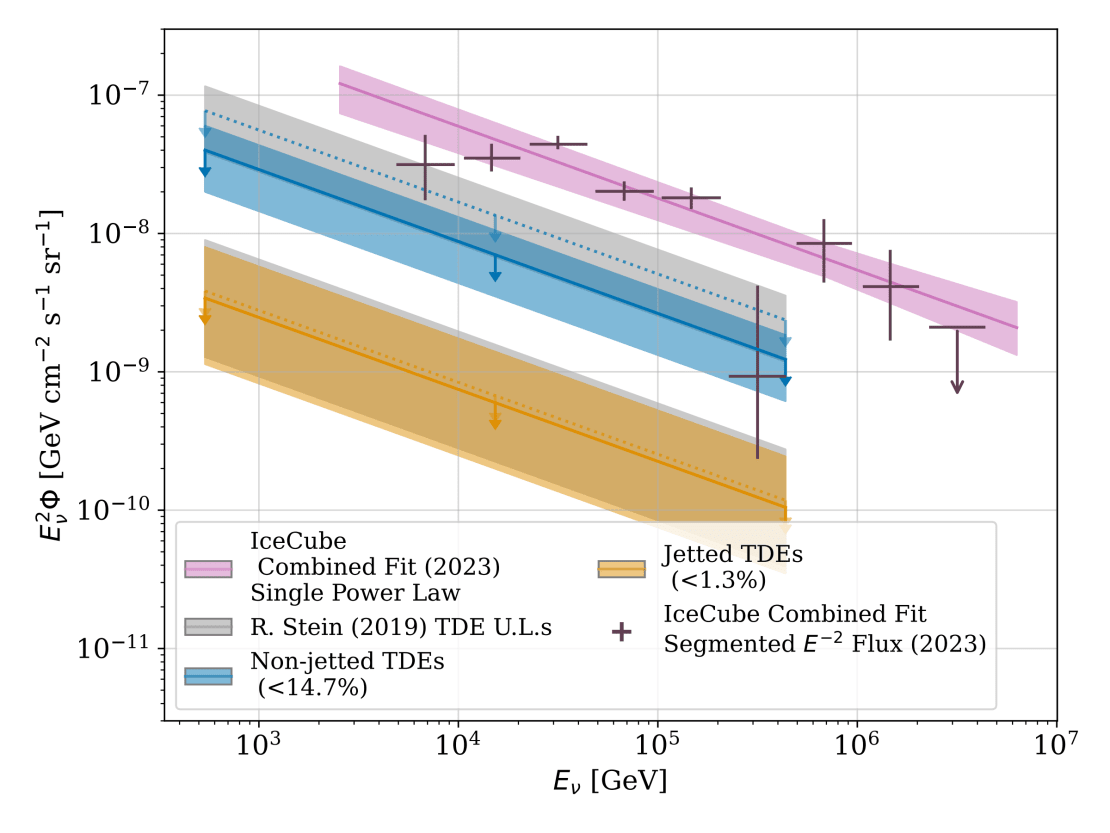
In a paper submitted to The Astrophysical Journal Letters, the IceCube Collaboration conducted a search for high-energy neutrino emission from TDEs. The nondetection of neutrino emission sets upper limits on the contribution from TDEs to the diffuse neutrino flux and improves upon a previous IceCube analysis that used a smaller TDE sample.

“Until recently, TDEs were observed infrequently, making it hard to study them statistically,” explains Shannon Gray, a recent PhD graduate from the University of Maryland who led the study. “New wide field-of-view telescopes like the Zwicky Transient Facility have dramatically increased the number of detected TDEs, giving us a larger sample to search for neutrino emission from.”
For the analysis, Gray assembled a catalog of 89 TDEs detected in optical, ultraviolet, and X-ray light and then searched IceCube’s data for any statistically significant clustering of neutrinos arriving from the same directions and times as the TDEs. The search was performed in two ways: 1) an individual search of each TDE and 2) a stacked search that combined the signals from all TDEs and looked for a collective signal that might be too faint to detect from a single source. An unbinned maximum likelihood method was then used to jointly fit the spatial, energy, and timing properties of each detected neutrino event to distinguish signal from background.
They found that nonjetted (no radio) TDEs contribute, at most, about 14.7% of that flux, and that the rarer jetted (radio) TDEs contribute at most about 1.3%.
“The Vera C. Rubin Observatory, a powerful new wide field-of-view telescope, is projected to detect over 3,000 TDEs per year, which is orders of magnitude more than we have today,” says Gray. “A larger, more complete catalog of TDEs will allow future searches using the same statistical framework to be more sensitive, potentially revealing a signal that is currently too faint to detect.”
+ info “Search for Neutrinos from Tidal Disruption Events with IceCube,” IceCube Collaboration: R. Abbasi et al. Submitted to The Astrophysical Journal Letters. arXiv