Since high-energy astrophysical neutrinos were first observed by the IceCube Neutrino Observatory in 2013, the IceCube Collaboration has continued hunting for their elusive sources. Thus far, IceCube has found compelling evidence that active galaxies are among the sources of high-energy neutrinos and likely sites of hadronic particle acceleration. While these sources were detected at high energies (TeV), venturing into the lower-energy GeV range would open up new opportunities for discovery.
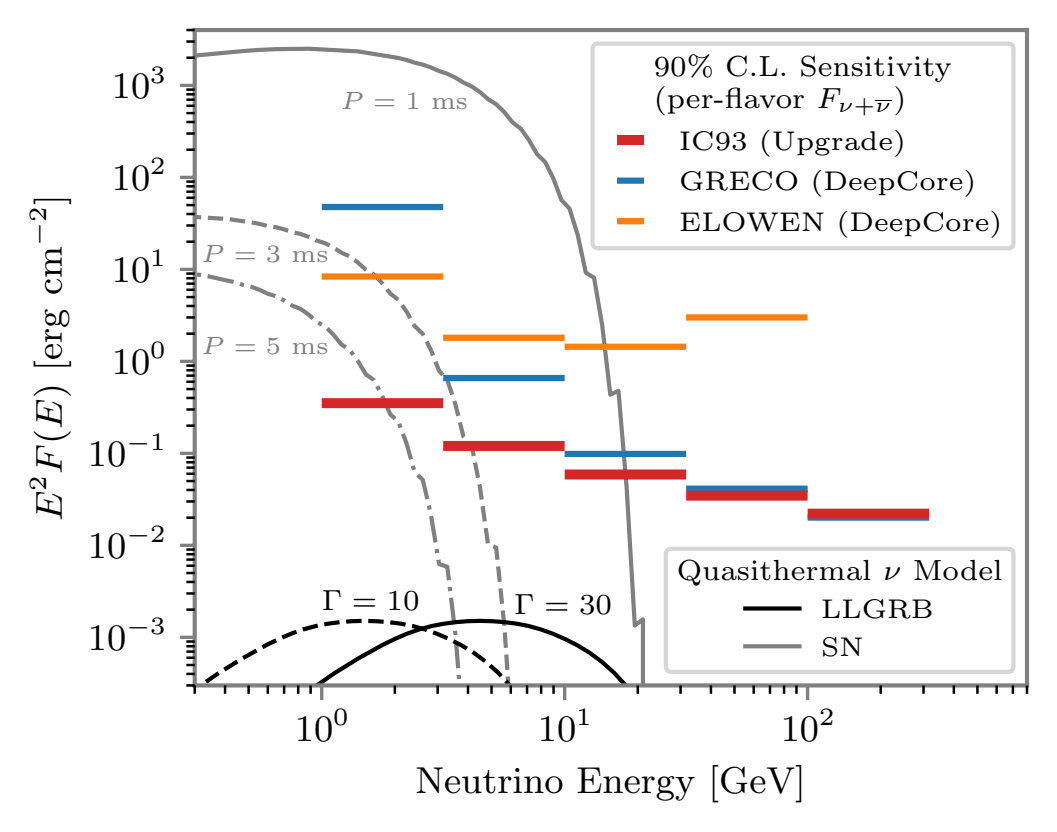
In a study submitted to Physical Review D, the IceCube Collaboration projected sensitivities of the recently completed IceCube Upgrade by extending three IceCube analyses: neutrino transient searches, steady emission from point sources, and diffuse emission from the Milky Way. They demonstrate that the IceCube Upgrade achieves an order-of-magnitude improvement in sensitivity at lower energies for transient sources across short timescales.
With the completion of the Upgrade, IceCube has been extended by five additional strings of newer light sensors along with calibration devices and other special devices. The Upgrade is expected to significantly improve the detection and reconstruction of neutrinos at GeV energies.
“Some neutrino production scenarios for transient phenomena, including gamma-ray bursts and supernovae, predict quasithermal neutrinos in the GeV energy range,” says Yukiho Kobayashi, a postdoctoral researcher at Chiba University. “Detecting such neutrinos provides unique insight into their subphotospheric mechanisms, making GeV observations particularly interesting.” Kobayashi coled the study along with Markus Dittmer and Berit Schlüter, PhD students at the Universität Münster.



Using simulations for the Upgrade, the researchers constructed mock background datasets and applied the standard likelihood method used in point-source searches. They then evaluated the sensitivity to neutrino bursts and steady emission for different source models, comparing the sensitivity to that of DeepCore, IceCube’s subdetector, which can observe lower energies.
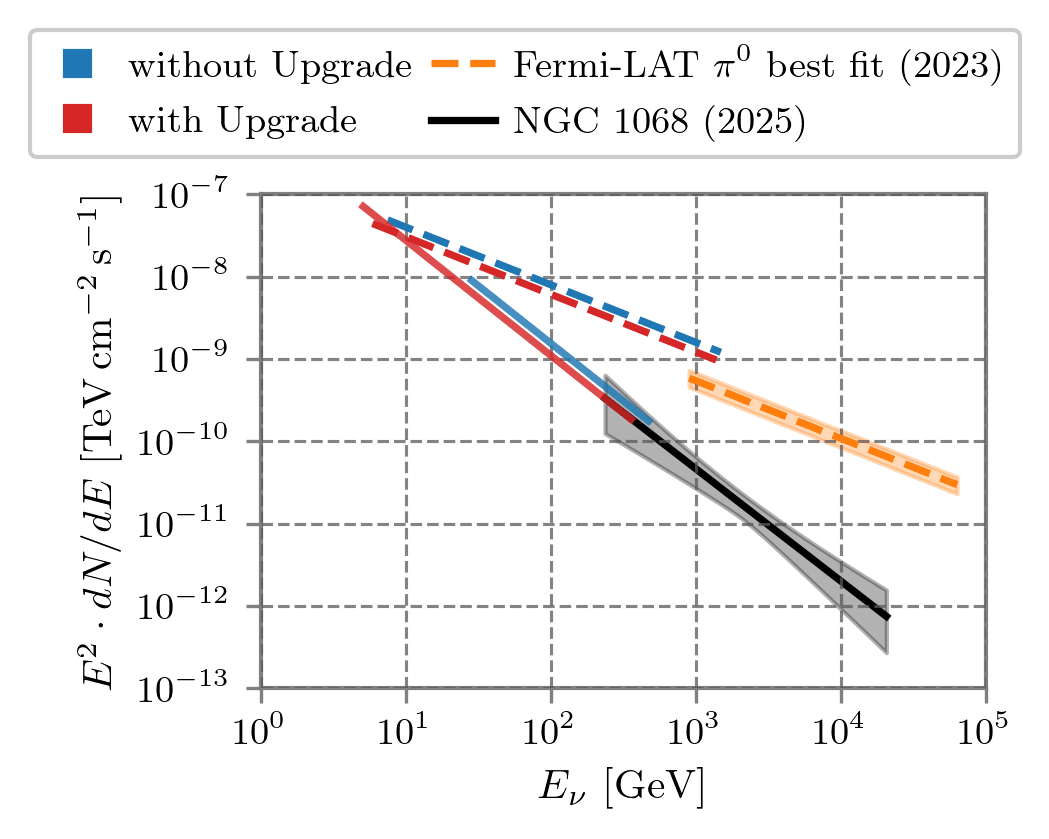
“For steady sources, such as NGC 1068, we found that the relative improvement is small due to a large amount of existing data from the IceCube detector,” says Dittmer. “A steady sensitivity improvement is expected over the coming years, with the most significant improvement expected for steady sources with a soft spectrum and for those located in the southern sky.”
Now that the IceCube Upgrade has been deployed, collaborators are eager to validate their simulations using real data, with the first data expected later this year.
“As we gain a better understanding of the detector during the commissioning and calibration phases, we will also be able to further optimize the analysis and improve its performance,” says Schlüter. “We look forward to presenting the first results from transient and steady source searches using the initial IceCube Upgrade data.”
+ info “Astrophysical Sensitivity Projections for IceCube Upgrade,” IceCube Collaboration: R. Abbasi et al. Submitted to Physical Review D. arXiv