The center of our galaxy offers a unique window into how cosmic rays are accelerated to extremely high energies. This region contains a large amount of dense gas and potential accelerators, including a supermassive black hole. Of particular interest to scientists are particles that can be accelerated to petaelectronvolt (PeV) energies, roughly 100 times higher than the maximum energies reached by human-made particle accelerators.
When high-energy protons (hadronic particles) interact with gas, they produce both gamma rays and neutrinos. The High-Altitude Water Cherenkov (HAWC) Gamma-Ray Observatory has detected gamma rays from the Galactic Center, suggesting that they originate from PeV proton-proton interactions with the surrounding dense gas. Three years ago, the IceCube Neutrino Observatory provided evidence of neutrino emission from the Galactic Center. If both gamma rays and neutrinos were detected from the same region, it would provide strong evidence for hadronic cosmic-ray acceleration at the Galactic Center.
In a joint analysis with the HAWC Collaboration, the IceCube Collaboration investigated the Galactic Center and searched for coincident neutrino emission using an updated HAWC dataset and 12 years of IceCube data. No significant signal of neutrino emission was found, and a new constraint was set on neutrino emission from the Galactic Center. The results are presented in a paper submitted to The Astrophysical Journal Letters.
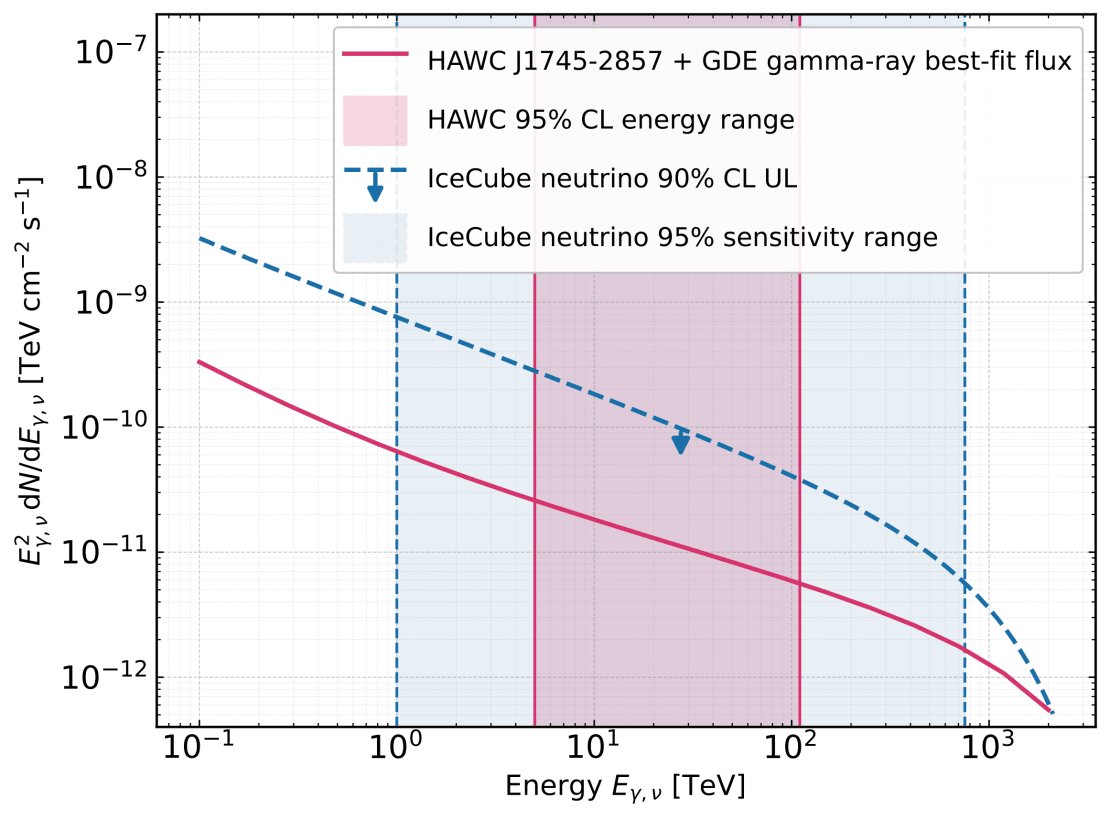
For the analysis, the researchers added an additional year of HAWC data with improved sensitivity thanks to machine learning. They tested different models for both the spatial distribution and overall pattern of gamma-ray emission before using the updated results as a template for predicting the corresponding neutrino signal within the Galactic Center.
“We focused on track-like events because they give us the best directional information about where a neutrino came from,” explains Sohyoun Yun-Carcamo, a postdoctoral researcher at Drexel University who led the study with Michigan State University postdoctoral researcher Rishi Babu. “The neutrino data was kept hidden while we developed and tested this hypothesis, which prevented our expectations from influencing the analysis choices and results.”

The results were consistent with the HAWC Collaboration’s previous observation, indicating that gamma-ray emission is strongly favored to have a hadronic origin. The data also favored the addition of a second, more spread-out gamma-ray component to the model, which can arise from the interactions of cosmic rays with the gas in the region as well as from unresolved sources.
“This diffuse emission has already been seen by low-energy gamma-ray observatories, but this is the first time it has been included in the HAWC Galactic Center model,” says Babu. “Including this diffuse component gives us a clearer picture of the gamma-ray emission we observe from the region and a more realistic footprint of what the neutrino emission looks like.”
Both Yun-Carcamo and Babu agree that future neutrino observatories, such as IceCube-Gen2, KM3NeT, and P-ONE, will provide more data and better sensitivity, helping researchers get closer to determining whether the Galactic Center is accelerating protons to PeV energies and, more importantly, whether the highest energy gamma rays have a hadronic origin.
+ info “Resolving the Galactic Center Region’s Gamma-Ray Emission and Searching for its Neutrino Counterpart with HAWC and IceCube,” IceCube Collaboration: R. Abbasi et al. Submitted to The Astrophysical Journal Letters. arXiv