Today in Stockholm, the Royal Swedish Academy of Science announced the 2026 Nobel Prize in Physics has been awarded to Francis Halzen, principal investigator of IceCube, “for decisive contributions to the IceCube Neutrino Observatory and the discovery of high-energy neutrinos of astrophysical origin.” Francis proposed and proved that ice could be used as a detection medium for high-energy astrophysical neutrinos and was a driving force behind forming the collaboration and establishing the observatory.
New ways of studying the Universe reveal new knowledge. Humanity has used visible and invisible light to do astronomy. Now neutrinos can also be used. Prosposing an in-ice detector was a bold idea. Building, operating, and conducting science with IceCube has been a technological tour de force, which is why it has been awarded the Nobel prize.

“It’s a great relief for me to finally deliver the recognition that this great collaboration deserves,” says Halzen. “This was a great surprise and is a celebration of a very unusual project. The success of this project involved the diligence and hard work of the many wonderful collaborators I’ve had the pleasure to work with.”
The U.S. National Science Foundation IceCube Neutrino Observatory discovered the high-energy neutrino flux from Nature’s accelerators by instrumenting a cubic kilometer detector within the pristine glacial ice at the South Pole. The international collaboration of 450 scientists, from 58 institutions in 14 countries, studies, among other things, the characteristics and origin of high-energy astrophysical neutrinos, cosmic rays, neutrino properties, and searches for beyond standard model physics. When IceCube discovered astrophysical neutrinos in 2013, the sources were not known. However, evidence for neutrino emission from two galaxies, TXS 0506+056 and NGC 1068 (Messier 77), has since been reported by IceCube. In 2023, IceCube also announced the observation of neutrinos from our own galaxy, the Milky Way.
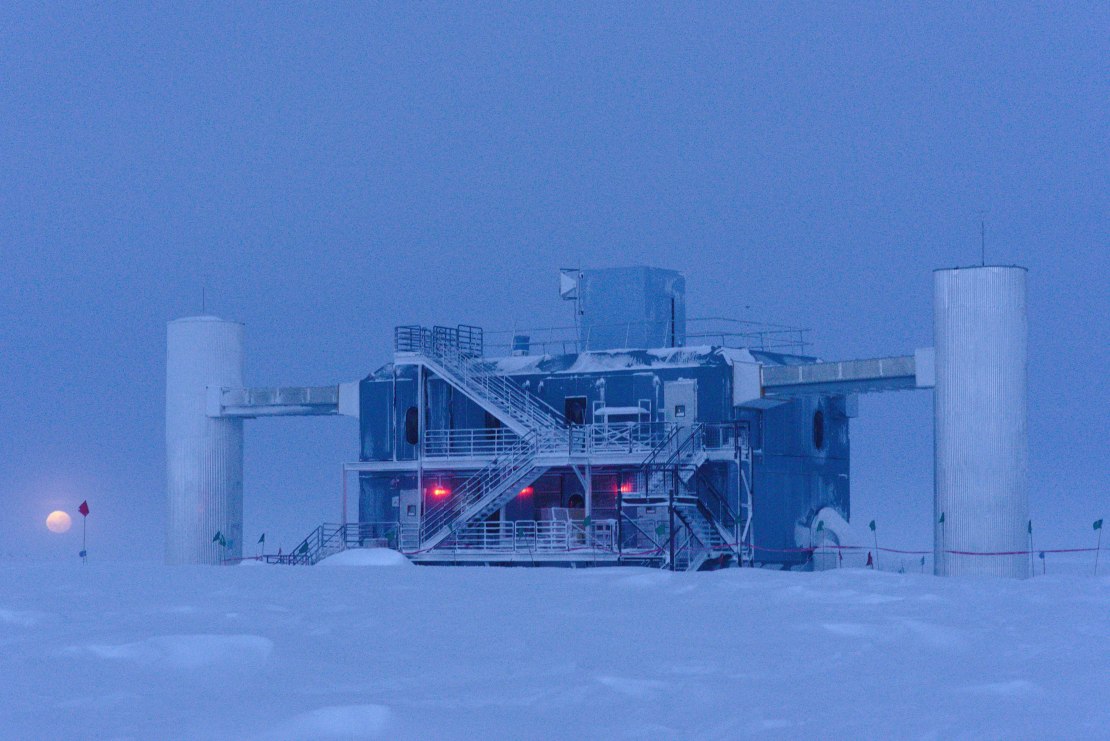
In 2025–2026, the IceCube Upgrade was installed to lower the energy threshold and better calibrate the ice, which will improve our ability to reconstruct the direction of the neutrinos within the detector. We are expecting the first science data with the IceCube Upgrade later this year.
“We are very proud of our research with IceCube and congratulate Francis on his well-deserved Nobel Prize. Francis continues to inspire us with the potential of the future of the field, where we can move from the first discoveries to robust detections,” says Erin O’Sullivan, spokesperson of the IceCube collaboration.
On the horizon is the proposed IceCube-Gen2, which includes an optical array with 8 times larger volume and the ability to measure even higher energy astrophysical neutrinos with the radio detection technique.
The IceCube Neutrino Observatory was funded and is operated primarily through an award from the U.S. National Science Foundation to the University of Wisconsin–Madison. The IceCube Collaboration, with over 450 scientists in 58 institutions from around the world, runs an extensive scientific program that has established the foundations of neutrino astronomy (https://icecube.wisc.edu/collaboration/institutions). IceCube’s research efforts, including critical contributions to the detector operation, are funded by agencies in Australia, Belgium, Canada, Denmark, Germany, Italy, Japan, New Zealand, Republic of Korea, Sweden, Switzerland, Taiwan, the United Kingdom, and the United States including NSF. IceCube construction was also funded with significant contributions from the National Fund for Scientific Research (FNRS & FWO) in Belgium; Federal Ministry of Research, Technology and Space (BMFTR), Helmholtz Association of German Research Centers and the German Research Foundation (DFG) in Germany; National Research Foundation of Korea, in Korea; Japan Society for the Promotion of Science (JSPS), and the Ministry of Education, Culture, Sports, Science and Technology (MEXT) in Japan; the Knut and Alice Wallenberg Foundation, the Swedish Polar Research Secretariat, and the Swedish Research Council in Sweden; Michigan State University and the University of Wisconsin–Madison in the U.S.
The U.S. National Science Foundation (NSF) is an independent federal agency that promotes the progress of science by investing in research to expand knowledge in science, engineering and education across all 50 states and territories. NSF supports nearly 2,000 colleges, universities and other institutions through competitive grants aimed at advancing science with broad impacts across the nation and its people. Learn more at nsf.gov.
Press contacts:
IceCube Press
press@icecube.wisc.edu
608-515-3831
NSF Media Affairs
media@nsf.gov
703-292-7090
University of Wisconsin–Madison Press
Will Cushman, wcushman@wisc.edu
(563) 543-2318
MEDIA KIT:
High-resolution headshots and other media assets are available here: https://uwmadison.box.com/v/Francis-Halzen
Additional photos here.
Additional information about Francis Halzen is available on the IceCube Neutrino Observatory website and on news.wisc.edu.