Four years ago, the IceCube Neutrino Observatory announced evidence for high-energy neutrinos emanating from NGC 1068, an active galactic nucleus (AGN) with a central, supermassive black hole that actively gobbles up surrounding matter. In AGNs like NGC 1068, X-rays can escape the dense environment around the supermassive black hole and provide information about its properties. In that same environment, neutrinos are thought to form if particles are accelerated and subsequently interact with the X-rays or surrounding matter. Recent studies from IceCube have strengthened the case that X-ray-bright AGNs are neutrino emitters.
The IceCube Collaboration investigated whether NGC 1068 and other sources emit neutrinos at lower energies using data taken from DeepCore, IceCube’s subdetector that can observe neutrinos down to a few GeV. No evidence for neutrino emission was found from any of the sources tested, and upper limits were set on the possible amount of emission from all of the sources. This analysis builds upon previous IceCube analyses of NGC 1068 and also stands as the first steady-state neutrino source search that uses DeepCore data. Their results were submitted to The Astrophysical Journal Letters.
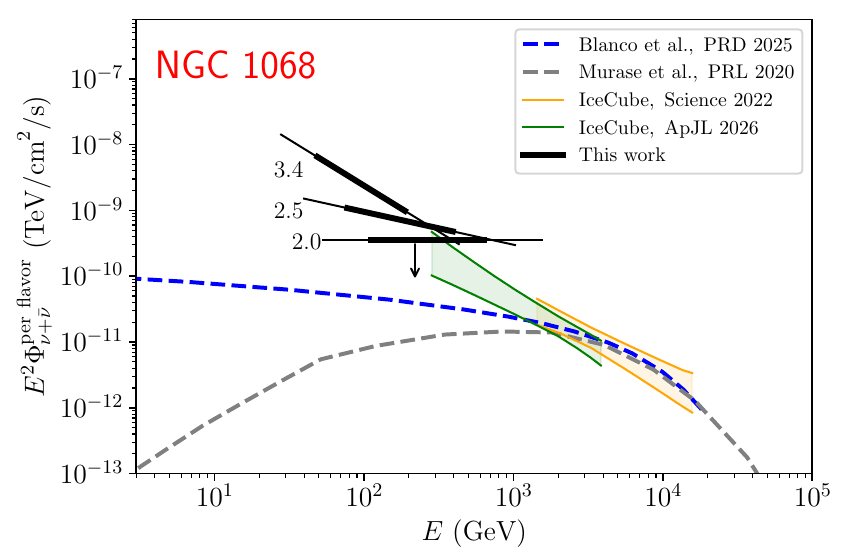

For the search, collaborators looked at steady-state neutrino emission from a variety of galactic and extra-galactic sources based on methods seen in previous IceCube analyses. Because of the lower-energy DeepCore neutrino events, the team devised novel analysis techniques in order to isolate high-quality data gathered for use in a steady-state analysis.
“With this analysis, we now have the capability to search for sub-TeV neutrino sources in a way that had not been possible before,” explains Andrew Wang, a PhD student at the Georgia Institute of Technology and study lead.
In total, three studies were performed: 1) a search for neutrino emission from X-ray-bright AGN, as identified by the SWIFT/BAT survey; 2) a search for neutrino emission from galactic objects identified by Fermi-LAT; and 3) an all-sky search for neutrino point sources.
“In many of these galaxies, the individual spectra seem to prefer neutrino emission towards lower energies,” says Wang. “We hope this analysis continues to fuel interest in the lower-energy emission regime, and we hope that future analyzers will find our techniques useful in pursuing that goal.”
+ info “Time-Integrated Searches for Sub-TeV Neutrino Sources with IceCube-DeepCore,” IceCube Collaboration: R. Abbasi et al. Submitted to The Astrophysical Journal Letters. arXiv