The nature of dark matter (DM) remains one of the greatest unsolved mysteries in modern physics. Although it is thought to make up 85% of all matter in the universe, scientists have yet to determine what it is made of.
A possible candidate for DM is theoretical particles called weakly interacting massive particles. When these particles crash into each other, it is thought that they “annihilate” or disintegrate into other particles, including neutrinos. Such processes are thought to take place in parts of the universe where DM is densely packed by gravity, most notably at the heart of our galaxy and the Sun.
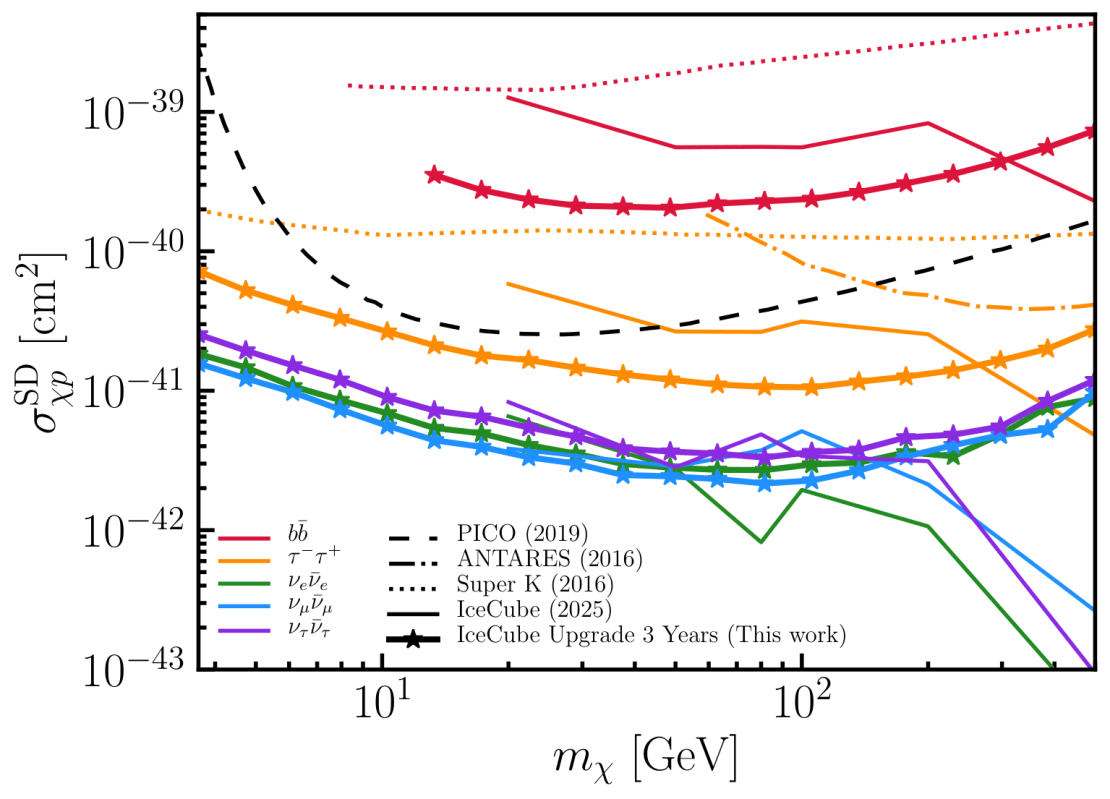
In a study recently submitted to the Journal of Cosmology and Astropartical Physics, the IceCube Collaboration modeled the sensitivity of the IceCube Upgrade to signals expected from DM annihilation taking place in the Sun and the Galactic Center. They found that the IceCube Upgrade can significantly improve upon the current DM limits set by the IceCube Neutrino Observatory and is expected to achieve leading sensitivities with only three years of data.

Earlier this year, the IceCube Upgrade was successfully deployed, adding more than 600 new and enhanced light sensors and calibration instruments to the ones already embedded in the ice. With the Upgrade comes two key advantages: the ability to more precisely pinpoint where neutrinos come from and the detection of up to a hundred times more events than before in certain energy ranges.


“Since the Upgrade has only just been deployed, we couldn’t use real data yet and so we used detailed computer simulations of how the upgraded detector would perform,” explains Eliot Genton, a PhD student at the Université libre de Bruxelles (ULB) and study colead. Genton led the study along with ULB postdoctoral researcher Thien Nhan Chau and Jeffrey Lazar, a postdoctoral researcher at the Université Catholique de Louvain.
“We simulated what a DM signal would look like (an excess of neutrinos coming from the direction of the Sun or the Galactic Center) and compared it against the expected backgrounds, which are mostly neutrinos and muons produced by cosmic rays hitting Earth’s atmosphere,” says Genton.
Using both directional and energy information, they produced a framework that could pick out a possible DM signal from background events. With the framework in place, they ran thousands of simulations across a number of DM hypotheses, including for low-mass DM particles and for different ways DM could annihilate.
“Now that the IceCube Upgrade has been successfully deployed, the natural next step is to apply these methods to real data as soon as it becomes available,” says Chau. “More importantly, our results demonstrate the strong potential of the IceCube Upgrade for indirect dark matter searches and help motivate the continued development of next-generation neutrino telescopes.”
+ info “Sensitivity Projections for Low-Mass Dark Matter Annihilation with the IceCube Upgrade,” IceCube Collaboration: R. Abbasi et al. arxiv.org/abs/2605.06600