Despite making up roughly 85% of all matter in the universe, the fundamental nature of dark matter (DM) still eludes scientists. Very little is known about it because it does not interact with light and is observed mainly via gravitational interactions.
A possible candidate for dark matter are theoretical particles called weakly interacting massive particles (WIMPs). When WIMPs are forced into very close proximity to other WIMPs, they can collide and destroy each other through a process called annihilation. The energy released from annihilation can lead to the production of new particles such as neutrinos, which are tiny, nearly massless particles that are the subject of study for the IceCube Neutrino Observatory.
The IceCube Collaboration performed a search for neutrinos from DM annihilation in dwarf galaxies. No significant excess of neutrinos was observed from these dwarf galaxies, and upper limits were set. The results were presented in a paper submitted to Physical Review D.
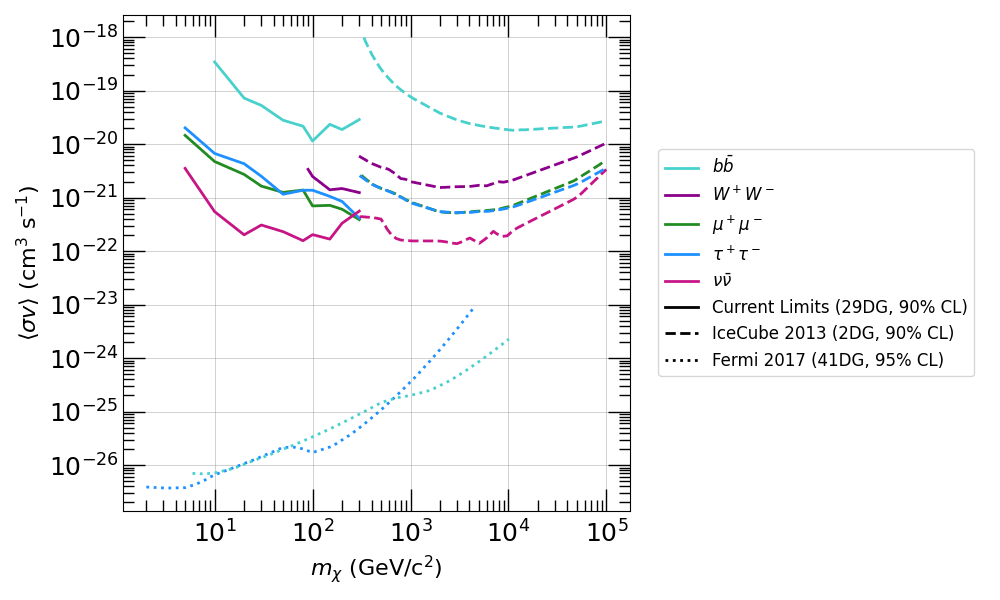

For the search, collaborators chose to hone in on satellite galaxies orbiting the Milky Way, called dwarf galaxies, that are densely packed with dark matter particles. They then modeled different energy distributions of neutrinos produced from WIMP annihilation, or spectra, which depend on the mass of the WIMP and the particles that were created from annihilation, or annihilation channels. The study focused on WIMP annihilation with masses lower than 300 gigaelectronvolts.
“We then modeled what we expect our background or noise to look like—that is, neutrinos coming from other processes that we need to ignore—and what we expect from neutrinos coming from WIMP annihilation,” adds Brandon Pries, who began the study as an undergraduate student at Michigan State University and is now a PhD student at the Georgia Institute of Technology. Pries co-led the study with MSU assistant professor Mehr Un Nisa.
Pries and collaborators then compared what they saw in seven years of IceCube data to the background and signal models, searching for neutrinos that were in excess of the background.
“These limits are important because they are IceCube’s first limits from dwarf galaxies for the range of WIMP masses that we tested,” says Pries. “Our lack of a detection highlights the need for continuing searches by both neutrino and gamma-ray detectors to further constrain the properties of WIMPs.”
+ info “Limits on GeV-scale WIMP Annihilation in Dwarf Spheroidals with IceCube DeepCore,” IceCube Collaboration: R. Abbasi et al. Submitted to Physical Review D. arxiv.org/abs/2511.19385