Neutrinos are tiny, nearly massless particles that can travel extraordinarily long distances unimpeded. Because of this, neutrinos act as “messengers,” harboring information about their cosmic sources. The IceCube Neutrino Observatory at the South Pole studies highly energetic astrophysical neutrinos that originate from the farthest reaches of outer space.
Neutrinos come in three different types or “flavors”: electron, muon, and tau. By studying the flavor composition—the ratio of muon, electron, and tau neutrinos—of cosmic neutrinos arriving at Earth, physicists can gain clues about the environment and the production and acceleration mechanisms of astrophysical sources. The expectation is that astrophysical neutrinos arriving at Earth would have a flavor composition of (1:1:1), reflecting a nearly even distribution among electron, muon, and tau flavors.
In a study recently submitted to Physical Review Letters, the IceCube Collaboration presents a new measurement of the flavor composition using 11 years of IceCube data. They found the ratio of all three neutrino flavors to be > 0 with more than 90% confidence, consistent with standard predictions and a first for IceCube.
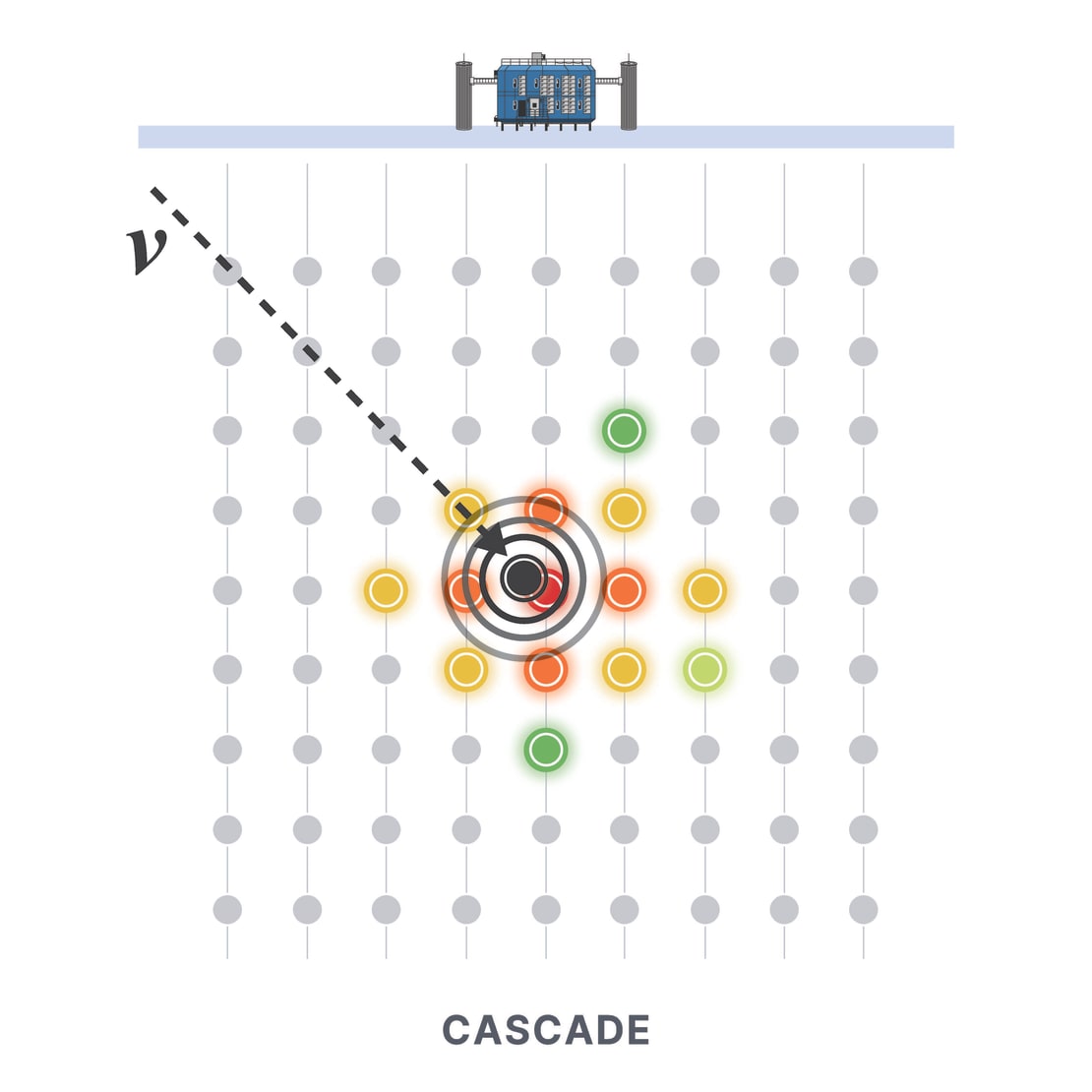

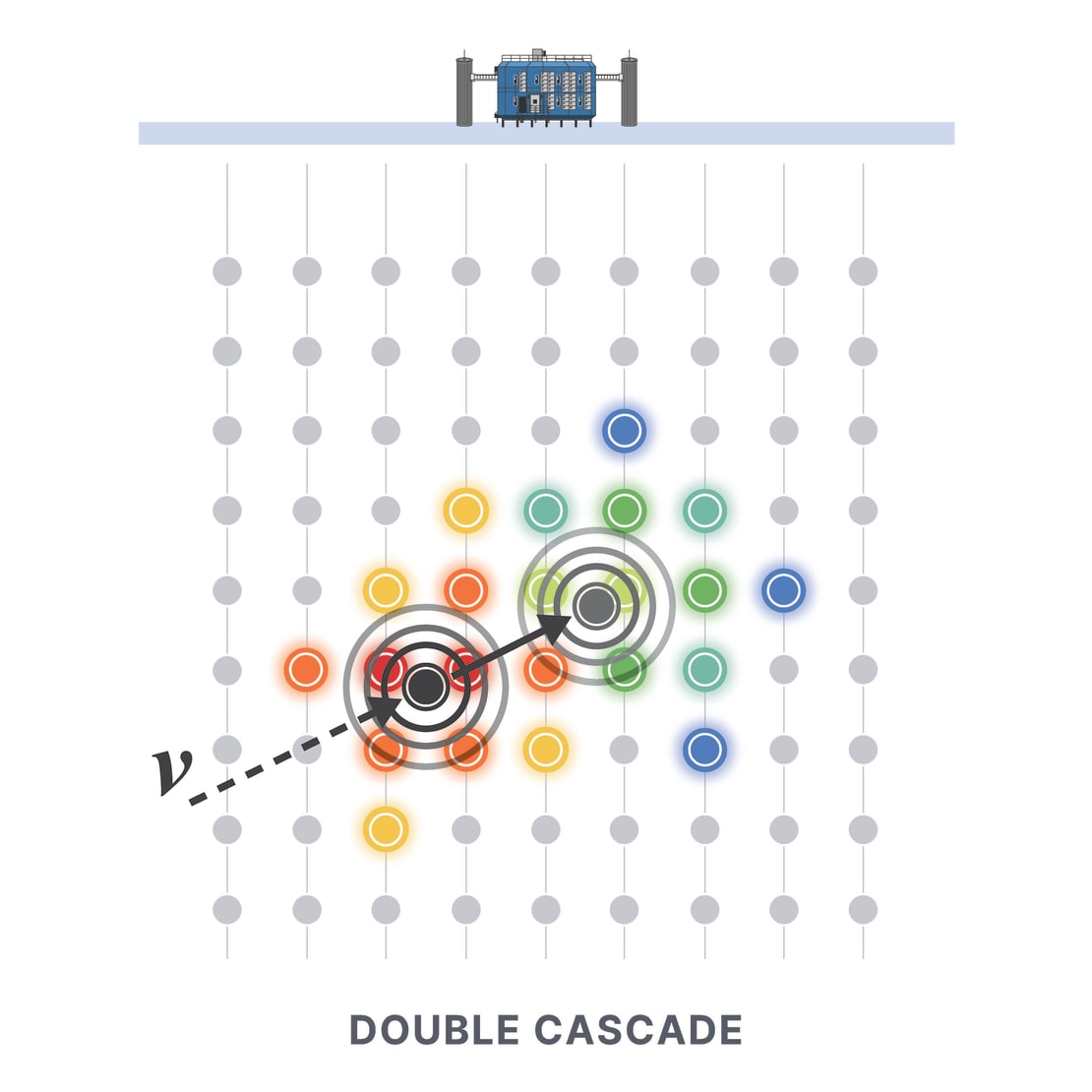
The IceCube neutrino detector, embedded in a cubic kilometer of Antarctic ice, is capable of measuring neutrinos of all flavors, across a wide energy scale. Through a process called Cherenkov radiation, blue light is emitted from the secondary charged particles that arise from neutrino interactions in the ice. This light is then picked up by an array of 5,160 optical sensors called digital optical modules (DOMs). These signals, known as “events,” are primarily tracks or cascades. Tracks occur when a neutrino collides with matter in or near IceCube, resulting in an elongated “track” of signals in its wake. Cascades happen when all or most of the neutrino’s energy is deposited in a small region that results in a nearly spherical event.
For the study, researchers classified the events into three morphologies: cascades, tracks, and double cascades, the latter of which is caused by the interaction of a tau neutrino. They then measured the neutrino flavor composition at Earth and further used that to infer the composition at their sources.


“We also ruled out neutrino decay as the dominant production of TeV-PeV scale neutrinos from astrophysical sources, with more than 99% confidence,” says Aswathi Balagopal V., a postdoctoral researcher at the University of Delaware who co-led the study with Vedant Basu, a postdoctoral researcher at the University of Utah. “These measurements advance our understanding of cosmic neutrinos and help constrain the properties of astrophysical sources.”
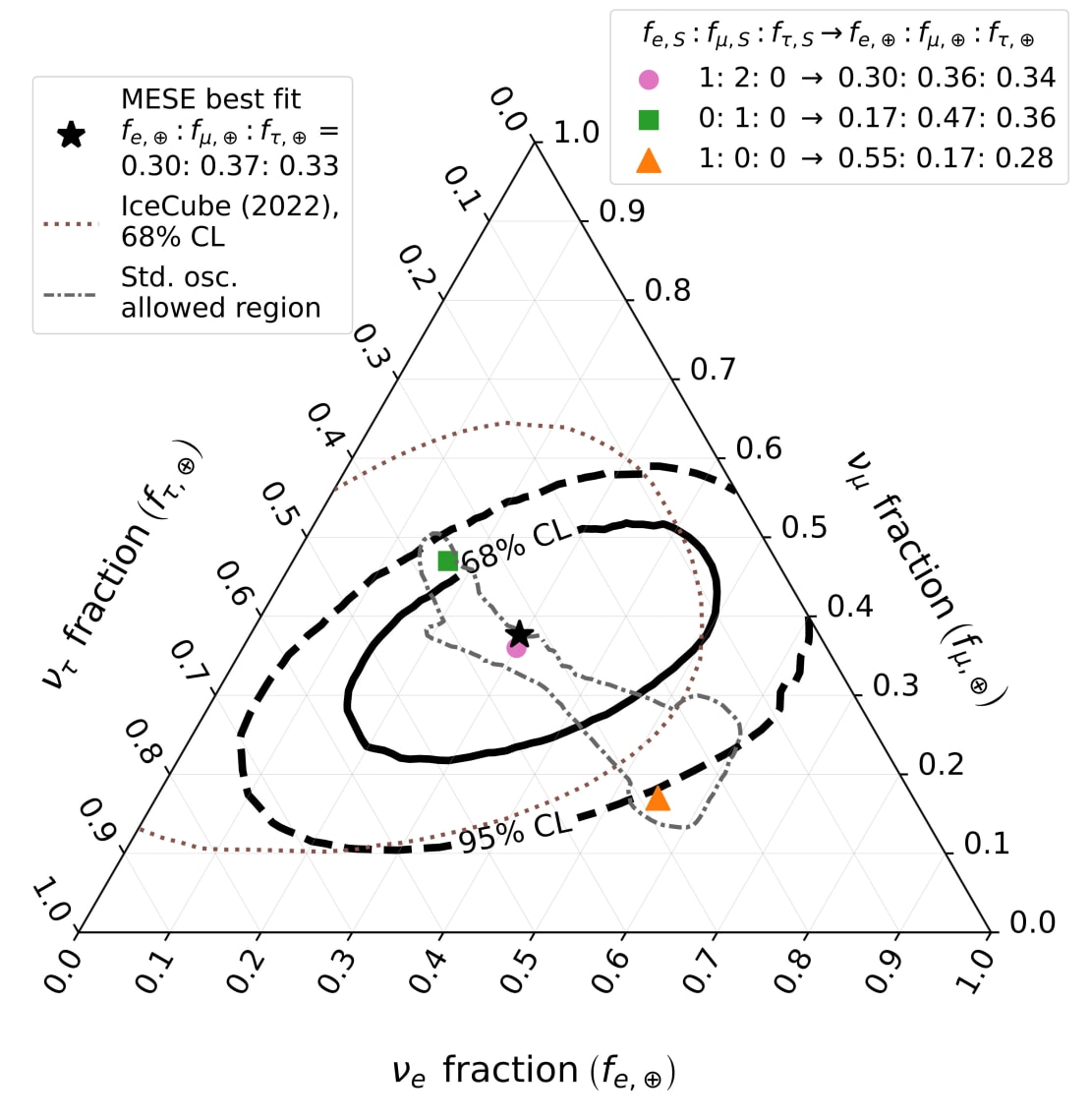
“Up until now, we were only able to make flavor composition measurements using traditional methods of tau neutrino identification,” says Basu. “Including neural network-based identification can improve our classification strength of tau neutrinos and distinguish them from the cascade and track identification done in this work.”
+ info “Characterization of the Three-Flavor Composition of Cosmic Neutrinos with IceCube,” IceCube Collaboration: R. Abbasi et al. Submitted to Physical Review Letters. arxiv.org/abs/2510.24957