
Earlier this month, more than 200 participants took part in the fall IceCube Collaboration meeting in Bochum, Germany. The meeting was hosted by the Ruhr-Universität Bochum.
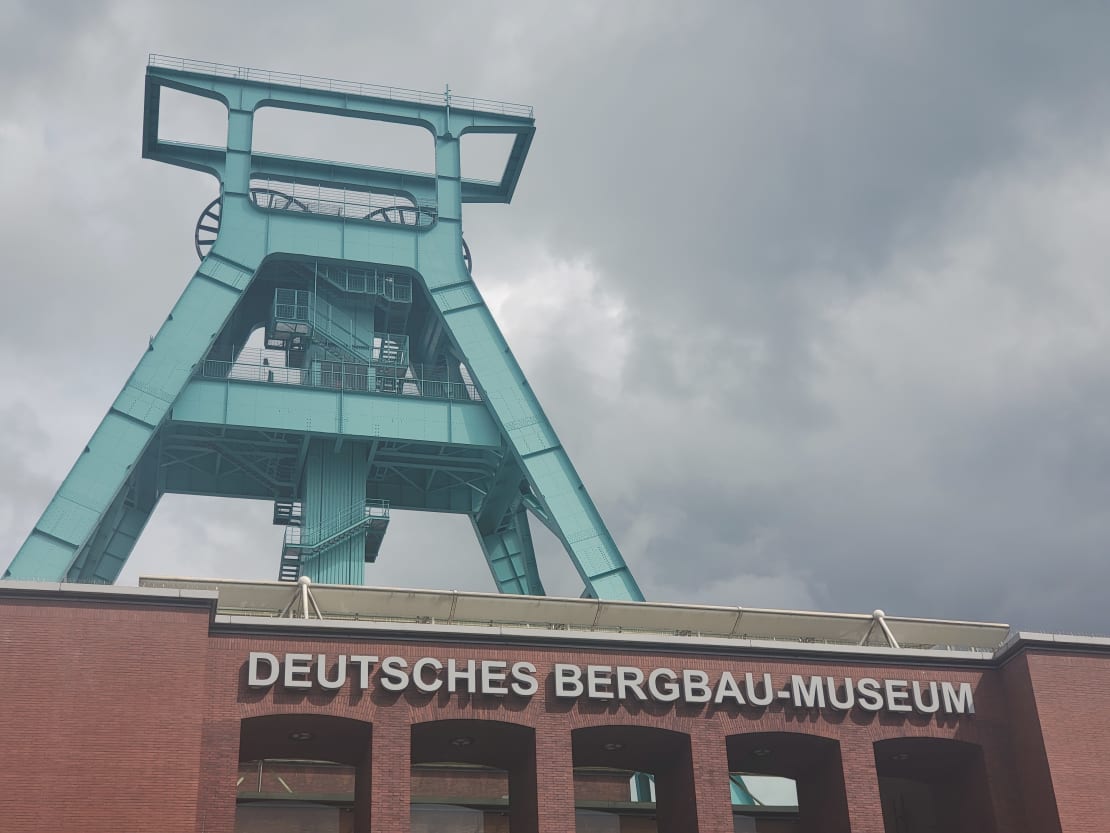
To kick off the meeting, Anna Franckowiak, a professor at Ruhr-Universität Bochum and cochair of the local organizing committee (LOC), gave welcome remarks, followed by remarks from Professor Achim von Keudell and Professor Sunhild Kleingärtner, the director of the Deutsches Bergbau-Museum. Later that evening, the welcome reception was held in the Planetarium Bochum.
“It was great to host everyone in Bochum, and the mining museum was a unique venue,” says Franckowiak.

Two representatives from the U.S. National Science Foundation, Dr. Saul Gonzalez, Deputy Directorate Head of the Directorate for Mathematical and Physical Sciences, and Dr. Camillo Mariani, NSF Program Director, attended the meeting in person. At the meeting, Gonzalez and Mariani met with many IceCube collaborators, including faculty members from US institutions, to learn about progress with the recently completed IceCube Upgrade, IceCube science, and future plans. The IceCube Collaboration thanks them for their time, engagement, and continued support of the project.
During the week, a number of discussions were centered on the Upgrade. Since its completion, the IceCube Collaboration is starting to see the first collected data. Many are excited to see what kind of results the Upgrade will produce in the months and years ahead.
There were also productive discussions and talks presenting activities and updates on IceCube-Gen2, software, calibration, and education and outreach. The meeting also included presentations on results of the latest IceCube analyses, such as neutrino oscillations, neutrino sources, physics beyond the Standard Model, and cosmic rays.
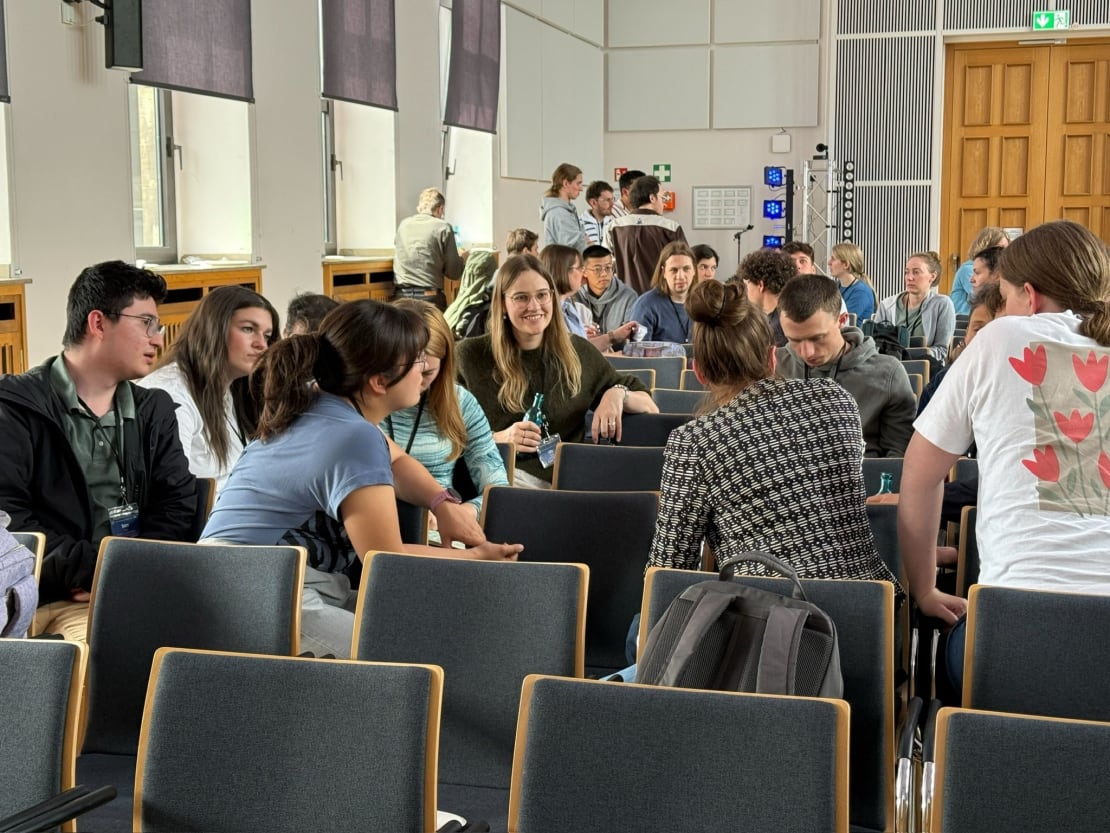
The inaugural luncheon for the IceCube community working group also took place during the meeting. Formed this year, the community working group aims to continue ongoing collaboration-wide efforts and promote a space to discuss community-related topics, exchange ideas, and coordinate activities. Already, the community working group implemented a way to anonymously ask questions at this year’s meeting.

Besides science, the meeting also provided plenty of socializing opportunities, such as a photo booth and planned activities like bouldering and board game nights and tours of the Deutsches Bergbau-Museum.
“I had a lot of fun organizing this year’s spring meeting in Bochum, especially the board game night,” says Jonas Hellrung, a PhD student at Ruhr-Universität Bochum and member of the LOC. “There was a big rush to the event, so the room was quite crowded with more than 50 people playing board games, card games, or pen and paper. It was great to see so many people not only discussing science but also just playing games and laughing with each other.”

“I was delighted that around 15 people came to the local bouldering gym,” says Vladimir Kiselev, a PhD student at Ruhr-Universität Bochum and member of the LOC. “The group brought together a wide range of experience, from beginners to more regular boulderers, and it was wonderful to see everyone supporting each other on the routes—very much in the spirit of the broad collaboration meeting.”
At the collaboration dinner, spokesperson Erin O’Sullivan announced the recipients of the thirteenth edition of the IceCube Impact Awards. The 2026 awardees are Vedant Basu (University of Utah); Emmett Krupczak (Michigan State University); Angela Zegarelli (Ruhr-Universität Bochum); and Timo Karg (DESY), recipient of the IceCube Legacy Impact Award.
At the conclusion of the meeting, many IceCubers stayed in Germany and attended other workshops to continue discussions on topics like the Upgrade and the tau neutrino.

“The LOC wants to thank everybody who came to Bochum and was part of this meeting. I think we were a great organizing team,” says Hellrung.
The next collaboration meeting will take place October 19-23, 2026, at the University of Wisconsin–Madison in Madison, WI.