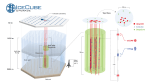
First field season for IceCube Upgrade ongoing at the South Pole

Over the past two months, a team of IceCube drill engineers have completed an impressive amount of work during the first of three consecutive field seasons for the IceCube Upgrade. The project is funded by the National Science Foundation and international collaborators. The goal of the project is to drill seven holes in 2025/2026 and […]

Read More »


Thai engineer joins the IceCube Upgrade project

Thai engineer Chana Sinsabvarodom was recently selected to work on the IceCube Upgrade project, which will install seven more densely instrumented strings of light sensors near the center of the IceCube array at the South Pole. The IceCube Upgrade will significantly enhance IceCube’s sensitivity to lower-energy neutrinos, improve the fidelity of all past and future […]

Read More »


Improved IceCube Upgrade optical module paves the way for IceCube-Gen2

The IceCube Neutrino Observatory, a cubic-kilometer-sized neutrino telescope, searches for high-energy neutrinos of astrophysical origin. Located at the geographic South Pole, IceCube consists of 5,160 digital optical modules (DOMs) across 86 vertical cables (strings) embedded deep within the Antarctic ice, as well as a surface array, IceTop, and a denser inner subdetector, DeepCore. When neutrinos […]

Read More »


IceCube Upgrade Neutrino Monte Carlo Simulation

Introduction The IceCube Upgrade is an upcoming extension to the IceCube neutrino observatory which will densely instrument a 2 Mton region in the deepest ice, within the existing DeepCore sub-array. This new sub-array will comprise 7 new strings featuring a total of nearly 700 multi-PMT optical modules (known as mDOMs and DEggs) at a vertical […]

Read More »


Putting neutrino masses in their place (soon!) with the IceCube Upgrade and JUNO

Neutrino mass ordering is one of the foremost problems in neutrino physics today. But two new neutrino oscillation experiments are on the horizon—the IceCube Upgrade and JUNO. So the IceCube Collaboration and the JUNO Collaboration studied the combined performance of their respective experiments, which employ very distinct and complementary routes in order to resolve the neutrino mass ordering. In a paper submitted recently to Physical Review D, they show that a combined analysis could eliminate the wrong mass ordering in as few as three years from the start of data taking. […]

Read More »