In 2022, the IceCube Neutrino Observatory at the South Pole announced evidence for high-energy neutrinos spewing from the “nearby” active galaxy NGC 1068. NGC 1068 is an active galactic nucleus (AGN) with a central, supermassive black hole that actively gobbles up surrounding matter.
Classified as a Seyfert galaxy, NGC 1068 is not dominated by a beam of matter shooting out of its supermassive black hole. Unlike gamma rays, X-rays emitted from supermassive black holes can reveal opaque sources where neutrinos can be accelerated and subsequently interact with matter and radiation in the environment. Neutrinos could be produced if particles are accelerated and subsequently interact with the matter and radiation in this environment.
In a new study, the IceCube Collaboration searched for neutrino emission from X-ray bright Seyfert galaxies in the southern sky. A new method improved the sensitivity of the search and enhanced the statistical significance of the results, which is presented in a paper published in The Astrophysical Journal Letters today.
The study was led by Ali Kheirandish, assistant professor at the University of Nevada, Las Vegas; Qinrui Liu, a former postdoctoral researcher at Queen’s University; Hans Niederhausen, a former postdoctoral researcher at Michigan State University; and Shiqi Yu, research assistant professor at the University of Utah.
“The identification of NGC 1068 as the strongest source in the Northern Hemisphere was consistent with the theoretical expectation that neutrino emission from the AGN’s core is correlated with the X-ray flux inside the source,” explains Kheirandish. “However, the majority of the brightest and closest Seyfert galaxies reside in the southern sky, where IceCube is traditionally less sensitive.”



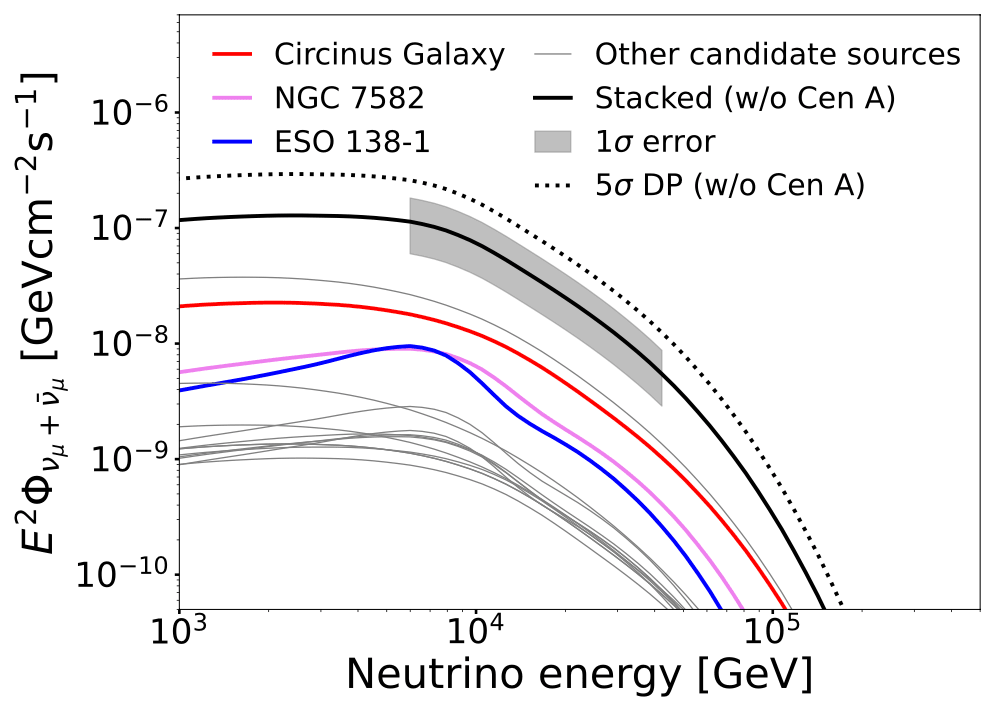
More recently, the development of the enhanced starting track event selection (ESTES) opened a new avenue for tackling this challenge. This method selects neutrino events that start within the detector, or starting tracks, allowing scientists to filter out atmospheric neutrinos and produce a cleaner sample. The researchers used 10 years of IceCube data containing starting track events and selected 14 Seyfert galaxies in the southern sky from the Swift Burst Alert Telescope AGN Spectroscopic Survey. They then carried out two complementary analyses: one that searched for neutrino emission from individual candidate sources and another that looked at the cumulative neutrino emission from an aggregation of sources.
“We found evidence of a collective neutrino signal from the selected X-ray bright Seyfert galaxies in excess of the background with a 3.0σ significance,” says Liu. “This finding benefits from the new event selection techniques, which improved the sensitivity towards the southern sky by effectively suppressing the large background.”
“This work introduces several significant advancements that enhance the search for neutrino signals from Seyfert galaxies,” adds Yu. “A major step forward is the implementation of a stacking analysis using weights derived directly from the theoretical model, providing a more physically grounded approach.”
These results support several recent IceCube results focusing on the Northern Hemisphere and strengthen the case that X-ray bright AGNs are neutrino emitters. With enhancements from the proposed IceCube-Gen2, the researchers will be able to more definitively confirm these astrophysical sources.
“Future work could extend this study of AGNs in the southern sky to include cascade signals recorded by IceCube for over a decade,” says Niederhausen. “I am excited about what these neutrinos will reveal in the future about the conditions near supermassive black holes.”
+ info “Evidence for neutrino emission from X-ray Bright Seyfert Galaxies in the Southern Hemisphere using Enhanced Starting Track Events with IceCube,” IceCube Collaboration: R. Abbasi et al., The Astrophysical Journal Letters 1000 (2026) 2, arXiv, iopscience.iop.org